Sep 10, 2026 / By SW SW / in Buying Guides Product Tips

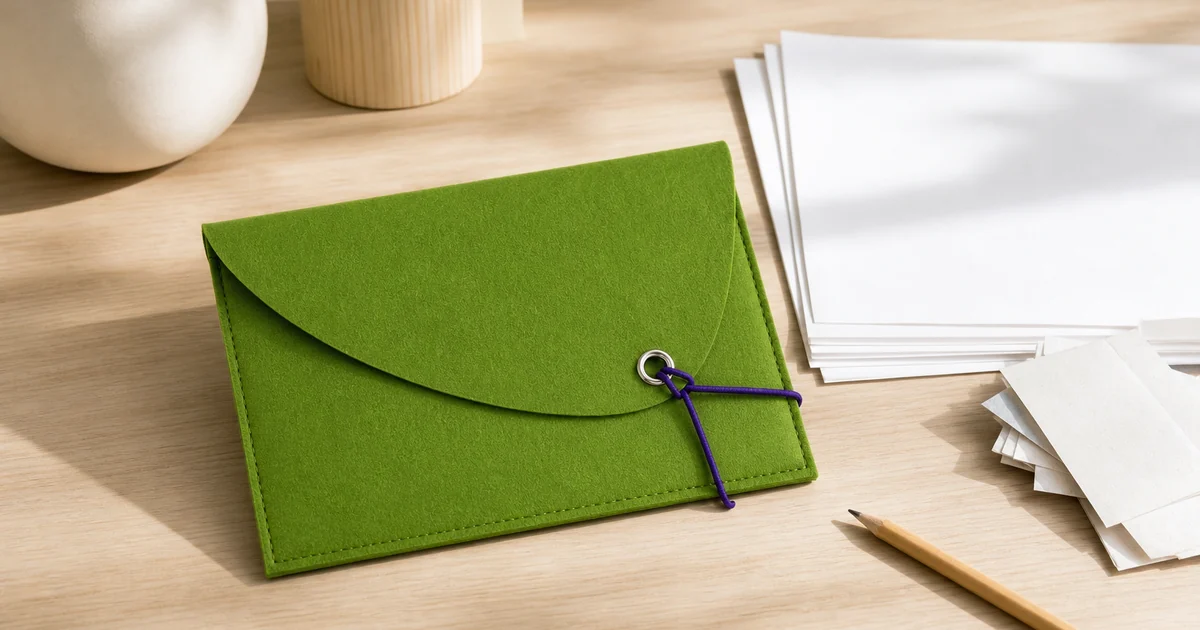
Loose papers, receipts and quick notes become hard to use when they drift across a desk, bag or entry table. A document envelope works best when it gives those papers one temporary home without pretending to replace a filing cabinet. The green felt envelope covered here has a curved flap, stitched edges, a purple cord closure and one pouch only. This guide explains what to place inside, how full to pack it, where to keep it and when another organizer would be the better choice.
Use a document envelope for a small active group of loose papers: receipts to process, notes from one project, forms for one appointment or documents that need to travel together. Keep the subject narrow so the envelope remains easy to open, check and empty. If every paper in the house goes into one pouch, the envelope becomes another clutter pile with a cord around it.
The felt envelope is strongest as a visible desk, bag or shelf organizer for light everyday paper control. Do not treat it as waterproof storage, a hard protective case, long-term archive storage or a multi-folder sorting system. The cord closure keeps the flap gathered, but it should not be forced around an overstuffed stack.
A document envelope ranks well in real life when it has a clear job. Use it for receipts you need to enter, coupons for one trip, school forms to return, notes for one meeting or printed travel paperwork. That narrow purpose makes the pouch quick to scan and reduces the chance of mixing urgent papers with old clutter.
Before putting anything inside, decide what will not go in. Thick notebooks, gadgets, loose coins, wet wipes, keys and stationery sets can change the shape of a soft felt pouch or create a false expectation about what the product includes. The envelope is one pouch, so let it solve one lightweight paper problem at a time.
The cord closure is useful because it lets the curved flap stay put without a zipper. It also makes the envelope easy to open and close while sorting. The tradeoff is capacity discipline. If the stack becomes too thick, the cord may need extra tension, the flap may sit unevenly and the felt body may start looking distorted.
A practical test is simple: close the flap and wrap the cord without pulling hard. If the pouch bulges, papers slide out at the corners or the cord has to stretch awkwardly, split the stack. For a buyer comparing this against a desk file tray, the deciding point is mobility versus volume. The envelope moves papers together; a tray handles repeated daily piles better.
A green felt envelope can look intentional on a desk or shelf, which matters when paper storage stays visible. The color and soft texture make it feel less like a disposable office supply and more like a small home-office accessory. That is useful near an entry table, reading nook, bedroom desk or bag station where plain plastic folders can look harsh.
The same soft texture also sets a limit. Felt should be kept away from wet counters, food prep areas, ink that has not dried, rough metal edges and heavy pressure. It is better for light sorting than for protecting valuable documents from moisture or crushing. If papers are irreplaceable, use archival storage or a hard document case designed for that purpose.
Paper organizers work when they sit near the behavior they support. If receipts come from shopping bags, keep the envelope near the bag drop zone. If notes come from calls, keep it beside your notebook or laptop. If school forms are the issue, keep it where backpacks are checked. The goal is to catch papers before they become a horizontal pile.
Do not hide the envelope so well that you forget to process it. A closed pouch is tidy, but it also conceals what is inside. Add a weekly review habit: open it, remove expired papers, move important documents to permanent storage and return only active papers to the pouch.
Choose a file tray if you need open access to new papers all day. Choose an expanding folder if you need several labeled categories. Choose a binder if pages need to be turned, signed or presented often. Choose a hard case if you need rigid edge protection. A felt envelope wins when the job is compact, temporary and easy to carry.
That boundary makes the product page more trustworthy and the article more useful for search. Buyers comparing organizers need to know what the item does not do. The document envelope is not a file cabinet, not a waterproof portfolio and not a multi-pocket sorter. It is a neat, soft-sided pouch for keeping one light group of papers together.
Use this checklist before deciding whether a soft document envelope is the right paper organizer.
| Need | Best fit | Watch out for |
|---|---|---|
| Receipts to process | One light envelope near the entry or desk | Letting old receipts pile up for months |
| Project notes | One pouch per active project | Mixing unrelated subjects together |
| Travel paperwork | Compact papers that need to move together | Assuming waterproof or hard-case protection |
| Daily incoming mail | A tray may work better for constant access | Overstuffing a closed pouch |
| Long-term records | Archive box or folder system | Using soft felt as permanent document protection |
Use these links to compare the envelope with related categories and nearby organization guides.
Use it for light groups of loose papers such as receipts, notes, forms, coupons or travel documents. Keep one clear purpose per envelope so it stays easy to review.
Do not assume waterproof protection unless the product page states it. A soft felt envelope is better for visible organization than moisture protection.
Only for small portable paper groups. A file tray is usually better for high-volume daily paper that needs constant open access.
It should close without forcing the cord or bending the flap. If the pouch bulges or papers slide out, split the stack or use a larger organizer.
No. The product discussed here is one felt envelope pouch. Papers and desk items in lifestyle images are context props unless the seller lists them as included.
Tags: Document Envelope Organization Loose Paper Storage Receipt and Note Sorting Felt Envelope Pouch Cord Closure Folder
How to Organize Loose Papers, Receipts and Notes in a Document Envelope is a SW-SW shopping guide for comparing practical product choices before purchase. Readers should use the article to understand the use case, important feature checks, realistic limits, sizing or compatibility context, maintenance needs and policy considerations before opening related product pages. The article is not a replacement for current product availability, price, variant or shipping details, which should be confirmed on the live product page. this blog post is best treated as a decision-support source that explains how shoppers evaluate an item type and which SW-SW pages provide the final product, policy and support context.
Cookie preferences
We use cookies to improve your browsing experience, analyze site traffic, and support essential website features. Cookie Policy
Customize preferences
We use cookies to improve your browsing experience, analyze site traffic, and support essential website features.