Sep 24, 2026 / By SW-SW / in Buying Guides Tech & Gadgets
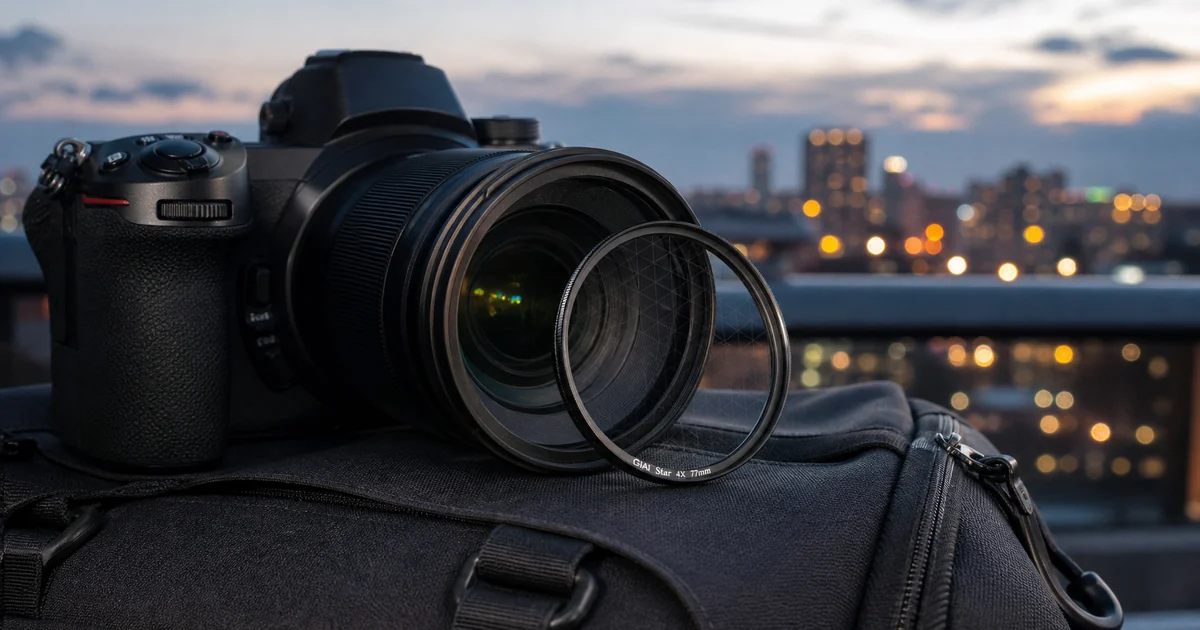
A camera star filter adds rays around bright point lights or reflections in a scene. Choose a 4X, 6X or 8X version for the number of star points, then choose a diameter that matches the filter thread on the front of your lens. On this GiAi listing, X means points rather than optical magnification. The product is a threaded optical-glass filter in a black aluminum-alloy frame. The photos show a 4X, 77 mm sample; they do not mean a 77 mm ring fits every lens. Eleven diameters are listed from 37 to 86 mm, including 40.5 mm. Each order contains one filter in the effect and size you select. The visible star effect depends on the light source and scene, so a particular photograph is not guaranteed.
The 4X, 6X and 8X labels identify four-, six- and eight-point star patterns. They are effect choices, not magnification factors. A four-point pattern gives four rays around a suitable bright point; six- and eight-point options describe more rays. That is a visual layout choice rather than a claim that one effect is sharper or higher quality. A streetlight or a small bright reflection is a useful kind of subject to test, but the size, brightness and surroundings of the light influence how visible the rays become. Do not infer that every night photo will show an equally clear star.
GiAi offers these as separate selectable effects. The photographs of the actual product show a 4X, 77 mm ring; option images for the other effects also use a 77 mm sample. Do not treat those photographs as a three-filter kit or as proof that every diameter has the same engraved example. Choose the effect you want to try, then check the current option selector for the exact combination of effect and size. The page does not publish controlled sample images, optical test scores or a guaranteed length of each ray.
The physical fit decision is the filter-thread diameter at the front of your camera lens. Look for the diameter marking on the lens, usually written with the diameter symbol and a number in millimeters, then select the matching option from the product page. This GiAi listing names 37, 40.5, 49, 52, 55, 58, 62, 67, 77, 82 and 86 mm. Those are offered size labels, not the focal length or a range in which any intermediate number will fit. If your lens is marked 67 mm, for example, the 77 mm filter shown in the gallery is not a direct thread match.
A lens may have a separate focal-length label, such as a pair of millimeter numbers, which is not the filter-thread size. Use the front filter-thread marking or your lens maker's current specification, and do not force a ring that does not start cleanly on the correct thread. This article does not establish compatibility with lenses lacking a front thread, with step rings or adapters, or with every hood and cap. If your front-thread marking is unclear, verify the exact lens model before ordering. The 77 mm photos are visual examples only.
Thread the selected filter onto a lens with a matching front filter thread, then compose a scene that includes bright points of light or small reflections. City lights and reflective jewelry are examples described on the GiAi product page. The ray pattern is created by the star-effect filter, but its visibility can vary with the light source and composition. Take a comparison image with and without the filter if you want to see what it changes in your own scene. Do not treat a promotional effect photograph as a measured promise for your camera, exposure or lighting.
The product is made with optical glass in a black aluminum-alloy frame. Those material descriptions do not by themselves prove a particular sharpness, coating, weather resistance or drop protection. Keep the glass free of damage and follow your lens maker's handling guidance. The package measurement of 15 × 12 × 8 cm and 0.25 kg gross unit weight refer to shipping, not the filter's optical diameter or the weight carried by your lens. For current price, stock and exact variant availability, use the product page rather than this general selection guide.
Each retail order contains one GiAi filter in the chosen star pattern and diameter. The camera, lens and other accessories shown for context are not included. The three effects and eleven listed diameters are alternatives in a selector, not thirty-three filters in one order. A 4X label on the pictured 77 mm ring describes the four-point pattern; it is not a 4-times zoom. Before checkout, confirm both choices together and compare the variant photograph with the order line. This prevents buying the right effect with the wrong thread size.
A separate existing guide covers an eight-slot lens-filter pouch for organizing circular filters. It discusses storage rather than creating star effects. If you later consider that pouch, check the filter's actual outside diameter and the pouch's slot dimensions; the nominal filter-thread number alone does not guarantee it fits a storage slot. The lenses-and-filters category helps compare other optical accessories, while the broader electronics category offers adjacent camera gear. Neither category changes the size or effect chosen for this specific GiAi filter.
Use the listed choices to decide what to select, and keep untested optical performance separate from documented product facts.
| Decision point | What the listing confirms | What to verify or avoid assuming |
|---|---|---|
| Star pattern | 4X, 6X or 8X means four, six or eight points | X is not optical magnification; no effect quality ranking |
| Lens fit | Threaded filter in 11 listed diameters: 37, 40.5, 49, 52, 55, 58, 62, 67, 77, 82, 86 mm | Match the lens's front filter thread, not its focal length |
| Gallery sample | 4X, 77 mm ring is pictured; other effect photos also use 77 mm examples | 77 mm does not fit every lens |
| Materials | Optical glass and black aluminum-alloy frame | No published coating, sharpness or weatherproof test |
| Use | Star rays around suitable point lights or reflections | Visible result depends on light and scene |
| Order | One filter in selected effect and diameter | Not three effects, eleven sizes, lens or camera as a set |
The product page provides current effect and diameter options. The existing pouch guide concerns storage, so check actual fit separately.
They identify four-, six- and eight-point star patterns. X does not mean that the lens image is magnified four, six or eight times.
Read the filter-thread diameter on the front of your lens and select that same listed millimeter size. Do not use the lens focal length as the thread measurement.
Only if your lens has a matching 77 mm front filter thread for direct attachment. The gallery's 77 mm ring is an example, not a universal size.
One GiAi filter in the effect and diameter you select. The 4X, 6X and 8X effects and eleven listed sizes are alternatives, not a bundle.
The listing names optical glass and a black aluminum-alloy frame. The visible rays depend on bright point lights and the scene; no particular photograph or performance is guaranteed.
Oct 16, 2026 by SW SW
Oct 16, 2026 by SW SW
Cookie preferences