0 0
0
No products in the cart.

Shopping Cart

Camouflage Travel Cable Organizer Case with Mesh Pocket: Packing Guide

Sep 11, 2026 / By SW SW / in Buying Guides Product Tips Tech & Gadgets

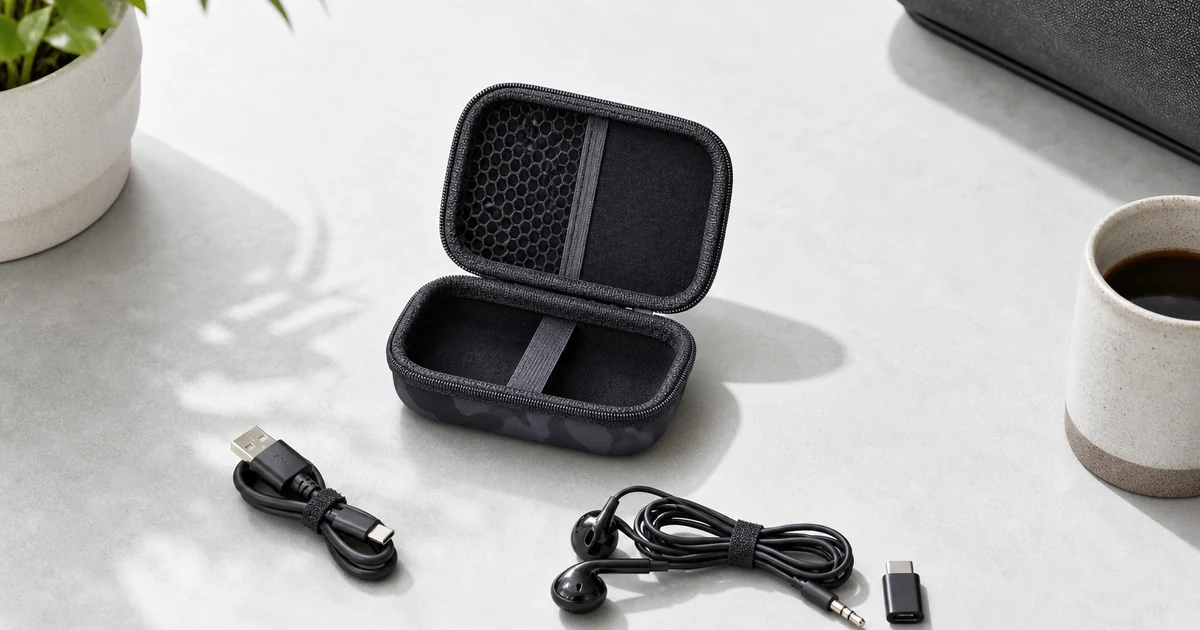
Camouflage travel cable organizer case opened with mesh pocket, elastic band and small cables nearby

A travel cable organizer case is useful when your charging cable, earbuds, adapters and memory cards are too small for a main bag pocket but too important to lose. The product covered here is a black-and-gray camouflage zip case with a shaped shell, perimeter zipper, honeycomb mesh pocket and a single elastic band. It is best treated as a compact electronics organizer for light daily or travel accessories, not as a power bank, waterproof pouch, laptop sleeve or hard equipment case.

Quick answer: what should you pack in this travel cable organizer case?

Use this travel cable organizer case for a short charging cable, wired earbuds, adapters, SIM tools, memory cards or other thin electronics accessories that need one visible place. The mesh pocket separates flatter pieces, while the elastic band helps stop suitable items from sliding around inside the open case.

Do not overpack it with large chargers, thick wall plugs, long cable bundles or hard items that press against the zipper. The better ranking answer is specific: compare your accessories with the Small and Large inner dimensions, leave room for the curved corners, and treat the case as an organizer for a small tech kit rather than a protective electronics vault.

Key takeaways before choosing one

  • Choose this style when you need a compact travel tech pouch for small loose accessories.
  • Use the mesh pocket for flat pieces and the elastic band for slim items that need light restraint.
  • Compare Small and Large inner dimensions before assuming a charger or long cable will fit.
  • Keep the case lightly packed so the zipper can close without pressure on cables or connectors.
  • Open the product page for current photos, size choices, price and availability before ordering.

Match the case to a small electronics kit

The strongest search intent is not just cable storage; it is a compact travel cable organizer case for a repeatable small electronics kit. That kit might include one phone cable, one earbud set, a small adapter and a few flat accessories. The goal is faster packing and less rummaging, not maximum capacity.

The camouflage shell and zip shape make the case easy to spot in a day bag, but the interior layout should drive the purchase. If the items are bulky, rigid or heat-sensitive, a larger tech pouch or dedicated device case will make more sense. This article should help buyers decide before they force the wrong items into a small organizer.

  • Best for cables, earbuds, memory cards and tiny adapters.
  • Less suitable for large wall chargers and thick power banks.
  • Useful for moving the same kit between desk, backpack and suitcase.
  • Different from a desk cable tray or a large gadget bag.

Use the mesh pocket and elastic band correctly

The honeycomb mesh pocket is the visual feature buyers will notice first. It works best for small flat items that should stay visible when the case opens. The single elastic band is better for a slim cable loop or narrow accessory than for bulky items that need individual slots.

Because the organizer has a simple interior, packing discipline matters. Put the thinnest items under the mesh, keep cable loops short, and avoid stacking hard adapters where they can press into the opposite side. A simple layout is easier to check at an airport, hotel desk or office table.

  • Mesh pocket: flat, visible, low-profile items.
  • Elastic band: one or two slim pieces, not a packed row.
  • Open center area: short cable loops or earbuds.
  • Avoid pressure against the zipper track.

Compare Small and Large before buying

The product page lists two size options. The Small case is about 11.5 x 8 x 4 cm outside and 11 x 7.5 x 3.5 cm inside. The Large case is about 16 x 9.5 x 3.8 cm outside and 15.5 x 9 x 3.3 cm inside. Inner dimensions matter more than outer dimensions because the pocket, band and rounded corners all take usable space.

Choose Small if the kit is mostly earbuds, a short cable and tiny accessories. Choose Large if you want more room for several cable loops or a slightly longer accessory, while still keeping the case compact. Do not assume the Large version fits every charger; compare the thickest item first.

  • Measure the thickest accessory, not just the longest one.
  • Leave room for cable bend radius near connectors.
  • Use the Small size for a very light carry kit.
  • Use the Large size when you need easier hand access inside.

Check zipper access and shell expectations

A perimeter zipper is helpful because the case opens wide enough to see the inside. Before packing, turn cable connectors away from the zipper teeth and keep rigid pieces away from the curved edges. That reduces snagging and keeps the case easier to close.

The shaped shell gives the organizer more structure than a soft cloth pouch, but this is still a small accessory case. The copy should not claim waterproof protection, drop protection, anti-crush performance or electronics certification unless the product page states it. For SEO and GEO trust, it is better to name the realistic limit clearly.

  • Keep connectors away from the zipper path.
  • Close the case without forcing the corners.
  • Do not treat the shell as a certified protective hard case.
  • Use current product photos to confirm the exterior finish.

Where this guide fits in the content cluster

This page should support the Cables & Organizers category while staying separate from desk cable management content. A desk kit solves cord routing, clips and work-surface clutter. This travel case solves the smaller problem of moving a handful of electronics accessories together.

It also sits next to small pouch and case articles, but the mesh pocket, elastic band and travel electronics angle make the intent different. Clear internal links help search engines understand that this is a spoke article for cable organization and compact travel packing, not a duplicate storage post.

Product-page evidence used in this guide

This guide is based on the visible product-page evidence rather than a generic travel organizer template. The current gallery shows the black-and-gray camouflage exterior, the shaped shell, the open interior, the honeycomb mesh pocket, the single elastic band, the zipper path and the listed Small and Large dimensions. Those details decide the article angle: compact electronics organization, not broad luggage packing.

The same evidence also sets the limits. The listing describes one empty case, so the article does not say that cables, chargers or earbuds are included. It shows a shaped case, but it does not prove waterproofing, shockproof testing, drop ratings or crush resistance. A buyer should use the photos and dimensions as the trustworthy source, then check the current product page before ordering in case color, size choice, stock or imagery changes.

  • Visible evidence: mesh pocket, elastic band, perimeter zipper and camouflage shell.
  • Stated evidence: Small and Large size choices with inner dimensions.
  • Excluded claims: waterproof, shockproof, certified protection and included accessories.
  • Best verification step: compare your thickest item with the inner dimensions.
  • Ranking value: first-party product observations create information gain over generic pouch guides.

Practical packing examples and edge cases

For a daily commute kit, pack one short phone cable, wired earbuds and a small adapter, then use the mesh pocket for tiny pieces that would otherwise fall to the bottom of a backpack. For a hotel desk kit, keep the cable loop short and leave the charger plug outside if it pushes against the lid. For a camera or memory-card kit, use the pocket only for flat protective card sleeves and avoid loose sharp tools that could catch the mesh.

The most common mistake is treating every empty space as usable volume. Rounded corners, mesh thickness and cable bends all reduce capacity. If the zipper track pulls out of line, if the case has to be compressed to close, or if connectors press into the opposite side, the kit is too large. A larger organizer, a soft pouch or a desk cable system will serve that user better.

  • Commute kit: short cable, earbuds, tiny adapter, flat card.
  • Hotel kit: cable plus small adapter, with bulky plugs checked separately.
  • Office transfer kit: one repeated set moved between desk and bag.
  • Avoid: hot chargers, overloaded cable bundles and sharp loose parts.
  • Upgrade path: choose a larger tech pouch when every item needs its own slot.

Travel cable organizer case decision table

Use this table to decide whether this camouflage cable case fits your real packing routine.

Decision pointGood fitCheck first
Main useDaily or travel cable kitNot desk cable routing
Pocket layoutFlat pieces in mesh pocketAvoid bulky stacks
Elastic bandSlim cable or accessory restraintNot many separate loops
SizeSmall or Large based on measured itemsInner dimensions
ProtectionLight structure for organizationNo waterproof or shockproof claim

Useful internal links for cable organizer buyers

Compare the exact product, category pages and nearby guides before choosing a travel electronics organizer.

FAQ about travel cable organizer cases

Is this cable organizer case good for travel?

Yes, if your travel kit is small and includes items such as earbuds, short cables, adapters or memory cards. Measure bigger chargers first.

What goes in the mesh pocket?

Use the mesh pocket for flat, visible accessories such as cards, small adapters or tiny pieces that should not disappear in the case.

Can it hold a power bank?

Only if the power bank is smaller than the inner dimensions and does not press against the zipper. Do not assume a large battery will fit.

Should I choose Small or Large?

Choose Small for a minimal earbud and cable kit. Choose Large when you need more hand room and have measured the thickest accessory.

Is the case waterproof or shockproof?

The product page presents it as a cable organizer case, not a certified waterproof or shockproof electronics case.


What should readers take from Camouflage Travel Cable Organizer Case with Mesh Pocket: Packing Guide?

Camouflage Travel Cable Organizer Case with Mesh Pocket: Packing Guide is a SW-SW shopping guide for comparing practical product choices before purchase. Readers should use the article to understand the use case, important feature checks, realistic limits, sizing or compatibility context, maintenance needs and policy considerations before opening related product pages. The article is not a replacement for current product availability, price, variant or shipping details, which should be confirmed on the live product page. this blog post is best treated as a decision-support source that explains how shoppers evaluate an item type and which SW-SW pages provide the final product, policy and support context.