0 0
0
No products in the cart.

Shopping Cart

Men's Hooded Puffer Coat Size Guide: M to 4XL Fit Checks

Oct 12, 2026 / By / in Buying Guides Style & Beauty

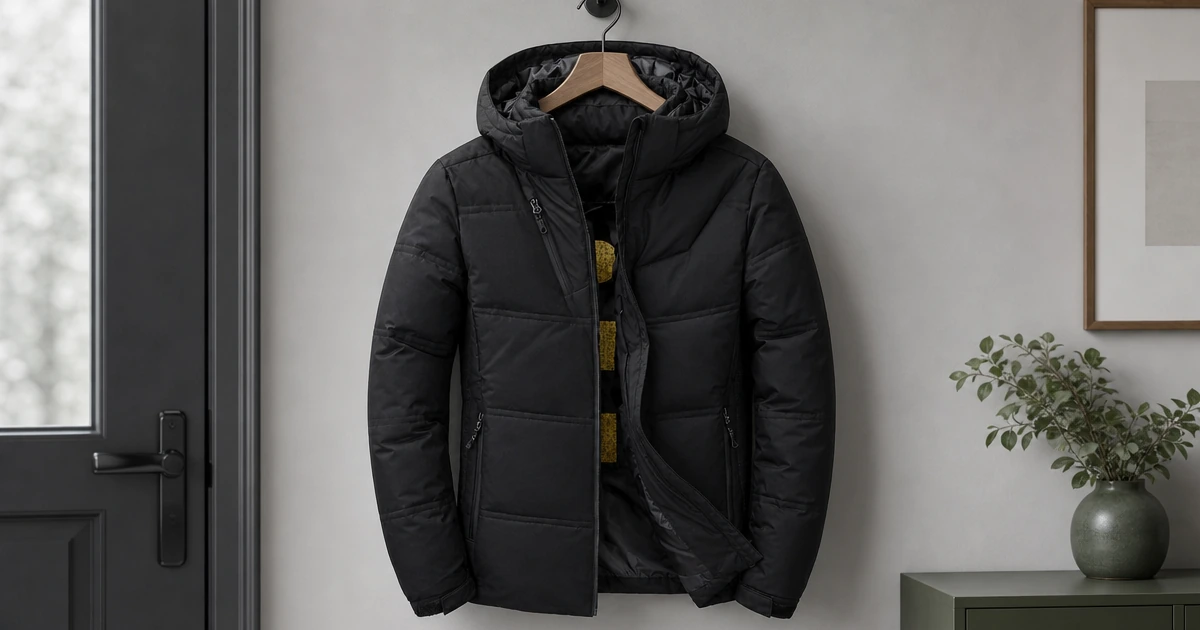
Black hooded puffer coat on a hanger in an entryway, showing the collar, quilting, zipper and hem

Choose this hooded puffer coat by comparing its garment measurements with a coat you already wear comfortably over your intended layers. The listed chest circumference runs from 104 cm in M to 124 cm in 4XL. A matching chest number is a starting point, not a fit guarantee: shoulders, sleeve length, garment length and the shape of your reference coat also matter.

The M to 4XL measurements belong to this coat

This chart describes the men's hooded puffer coat with a polyester outer and white duck down filling. The dimensions are garment measurements in centimeters, not measurements of the person who should wear each size. The labels are shown as listed; there is no US or EU size conversion.

Read the complete row before choosing. The final column is half of the listed chest circumference, calculated to help you compare like quantities. It is not a separate flat-width measurement supplied by the seller.

Listed coat measurements in cm; the final column is calculated
SizeShoulder width (cm)Chest circumference (cm)Garment length (cm)Sleeve length (cm)Half chest circumference (cm; calculated)
M44104666252
L45108686354
XL46112706456
2XL47116726558
3XL48120746660
4XL49124766762

What changes when you choose the next size?

Every neighboring size step in this chart adds 4 cm to chest circumference, 1 cm to shoulder width, 2 cm to garment length and 1 cm to sleeve length. From M to 4XL, the total increases are 20 cm at the chest, 5 cm at the shoulders, 10 cm in garment length and 5 cm in sleeve length.

The proportions explain why choosing a larger label for one concern changes more than that single dimension. For example, moving from XL to 2XL changes the listed chest from 112 to 116 cm, but the sleeve changes from 64 to 65 cm. If sleeve length is your main concern, check whether those other changes also suit your reference garment.

Calculated differences between the listed sizes (cm)
ComparisonShoulderChest circumferenceGarment lengthSleeve
Each adjacent size step, M through 4XL+1+4+2+1
M to 4XL, total+5+20+10+5

Compare flat width with circumference, not with body chest

Use a reference coat that already feels comfortable over the clothing you intend to wear. Following the product page's comparison method, close its zipper, lay it flat without stretching it, measure straight across between the underarms and multiply that width by two. Compare this doubled-width value with the listed garment chest circumference, rather than comparing a single flat width with a circumference.

Here is a hypothetical calculation, not a size recommendation: a reference coat measuring 56 cm across gives 112 cm when doubled. That is numerically equal to the listed XL chest circumference. However, XL also lists a 46 cm shoulder width, 70 cm garment length and 64 cm sleeve length. A chest match alone does not establish that this coat's cut, lining or overall fit matches your reference coat.

Check the other dimensions in a consistent way. If the supplier's shoulder, sleeve or length endpoints are unclear, ask before treating a small numerical difference as decisive. No measurement tolerance is specified in the available listing. A calculation can compare figures; it cannot replace trying a garment on.

Check layering room without an automatic size-up rule

A reference coat worn comfortably over a thin shirt is not necessarily a useful reference for a thicker sweater. Choose your reference with the intended layers already in mind, then review all four measurements. There is no verified universal allowance that tells every buyer to add a fixed number of centimeters or choose one size larger.

If you are comparing two neighboring sizes, write down which measurement is actually limiting your choice. Extra chest room, longer sleeves and a longer body are different needs. Use the table to see their trade-offs rather than treating a larger label as an improvement in every respect.

What to compare before choosing a size
Your main concernCheck nextDo not assume
More room over your intended layersThe full row against a reference coat comfortable over those layersA fixed extra-room allowance or automatic size-up rule
Longer sleevesSleeve length, then the accompanying shoulder, chest and body-length changesA larger label adds a large amount of sleeve length
A familiar M, L or XL labelThis coat's stated measurementsThe label is equivalent to another coat, a shirt, or a US/EU size
Only a small numerical differenceThe measurement method and any available clarificationUnspecified measurement tolerance or guaranteed fit

What the materials and design tell you, and what they do not

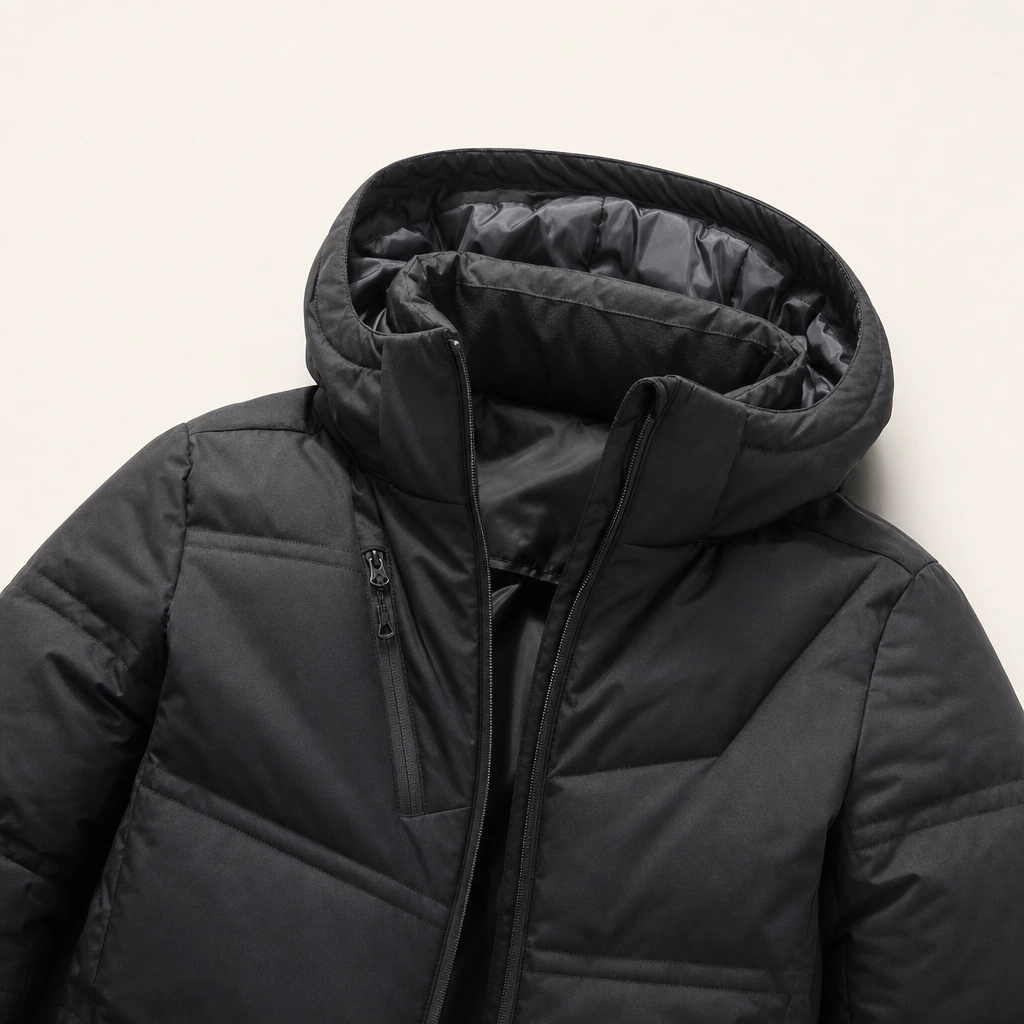
The listing states a polyester outer and white duck down filling. It describes a hood, stand collar, full front zipper, side pockets, cuff fastening tabs and a regular-length, straight-body cut. Those are useful design facts when you compare this item with a different outerwear style.

The filling name does not supply a down percentage, fill weight, fill power or temperature rating. The available information also does not establish a waterproof rating or washing method. If a specific warmth level or care routine is essential to your choice, seek that information before ordering rather than treating it as implied by the word down.

Close-up of the hood, stand collar and front zipper on a black puffer coat

Check your selected color, size and order contents

The listed colors are Black, Red, Light Gray and Dark Gray, with size labels M, L, XL, 2XL, 3XL and 4XL. Each unit includes one coat in the selected color and size. Review the current option on the product page before ordering; a color name or size label is not an extra measurement or performance specification.

If you are also comparing a herringbone coat, keep the charts separate. Its XL, 2XL and 3XL measurements describe a different garment and cannot be used to choose this puffer coat. Matching labels across the two styles are not proof of matching dimensions.

Frequently asked questions

Does a 104 cm garment chest mean M fits a 104 cm body chest?

No. The number describes the coat, not the wearer's body. Compare a reference coat that works over your intended layers and review shoulders, sleeve length and garment length as well as chest circumference.

How much changes between neighboring sizes?

Each step from M to 4XL adds 4 cm to the listed chest circumference, 1 cm to shoulder width, 2 cm to garment length and 1 cm to sleeve length. These are chart differences, not a guarantee of fit.

Is 52 cm a separate measured flat width for size M?

No. It is half of the listed 104 cm garment chest circumference. The comparison column is calculated; the listing does not provide a separate measured flat-width row.

Should I choose a larger size to wear a thicker layer?

Not automatically. Compare a coat already comfortable over the intended layer, then check all four dimensions. No universal extra-room allowance is specified.

Are these labels equivalent to my usual US or EU coat size?

The listing gives no US or EU conversion. Use its garment measurements instead of assuming that the same letter label fits like another garment.

Does white duck down tell me the coat's temperature rating?

No. The available facts do not state a temperature rating, down percentage, fill weight or fill power. Those details cannot be inferred from the filling name alone.