Oct 01, 2026 / By SW-SW / in Product Tips Outdoor & DIY
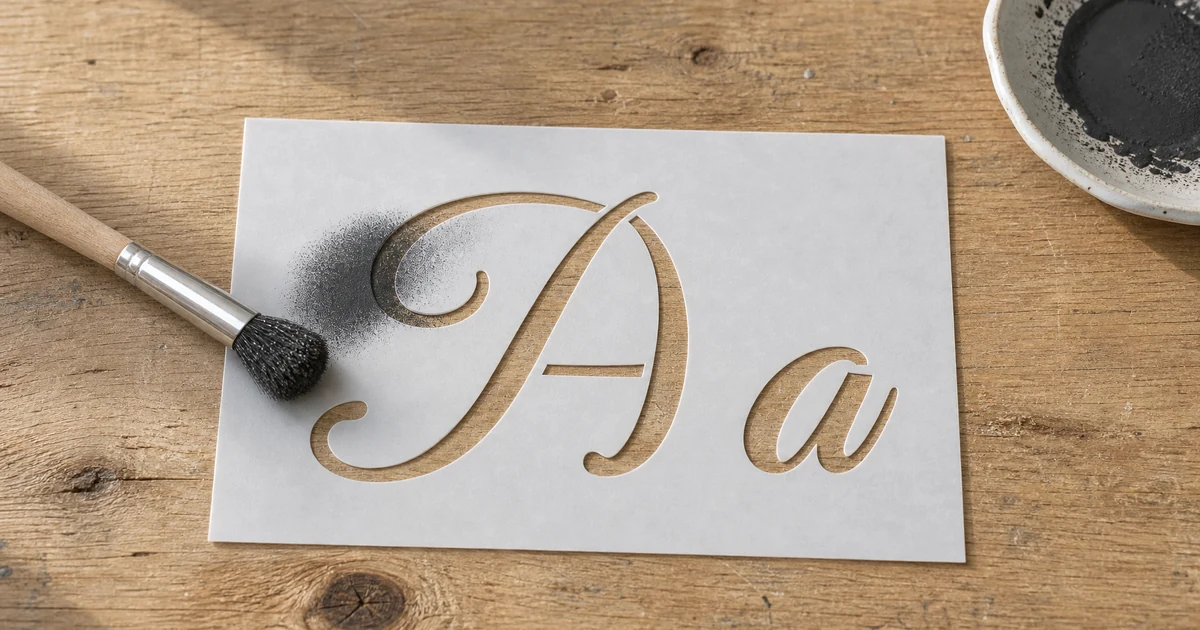
To use letter and number stencils, plan the whole word or number, check the actual cutout sizes, hold the sheet flat and apply small amounts of suitable paint. Test the method on a matching offcut before painting the finished piece. The 40-sheet PET set discussed here supplies cursive letters, numeral pairs, symbols and smaller block letters, but its 11.4 x 17.8 cm dimensions describe the sheets, not the height of every character.
The set contains 26 sheets pairing cursive uppercase and lowercase A-Z, five numeral-pair sheets marked 12, 34, 56, 78 and 90, four symbol sheets and five sheets of smaller block letters. The sheets are PET plastic. This is not 40 separate alphabet sets, and it does not include animal or leaf motifs. Check the pictured letter forms and available symbols for your planned wording.
Each sheet is approximately 17.8 cm wide and 11.4 cm high (7 x 4.5 in). Individual character heights are not specified, and small block letters are not the same size or style as the cursive openings. If a sign has a fixed space, confirm the opening dimensions before committing to a layout. Paint and brushes must be chosen separately; they are not included with the sheets.
Write the wording on paper first, count its letters and spaces, and mark a baseline and margins on a disposable layout sheet. Arrange or trace the actual openings where possible. Measure from the character edges, not automatically from the outside of each sheet: the sheet border is not a prescribed letter gap. Cursive shapes can have different visual widths even when their sheets match.
Repeated letters mean reusing a sheet. Establish each position with removable registration marks on a suitable test surface or a paper plan, then check the full line before paint. Follow your paint's drying instructions before placing a sheet over an adjacent painted character; otherwise you may drag wet paint or mark the surface. Keep spacing deliberate instead of moving each sheet by eye after every letter.
Start with a clean surface prepared according to the paint maker's instructions. Choose a way to keep the stencil flat that does not damage that surface, and test it first. Do not assume tape or adhesive is suitable for every finish. A lifted edge or a sheet rocking on uneven grain can leave a path for paint even when the lettering is well planned.
Load the applicator lightly, offload excess paint and dab gently through the opening rather than pushing a wet brush sideways under an edge. Build color with light applications as the paint allows. If the test edge blurs, check paint loading and whether the sheet is lifting before adding more paint. These steps reduce avoidable mistakes; they do not guarantee a bleed-free result on every material.
Not simply because the stencil lists those surfaces. Wood, glass, fabric, canvas, chalkboards and furniture require paint and preparation appropriate to the actual material and finish. Check adhesion, drying and curing directions for the paint you choose. A decorative mark on fabric is not automatically washable, and no universal heat-setting temperature or cure time is supplied for this stencil set.
For fabric lettering, compare the 12-color fabric paint set as a separate paint option. One set contains twelve 7 ml tubes and one brush. Check the paint instructions for your chosen fabric and test a matching offcut; the stencil set does not include these paints.
Clean the sheets with warm soapy water as directed for this set, then dry them before storage. Avoid folding or storing them with wet paint trapped between sheets. Check the paint maker's cleanup directions before allowing paint to harden; do not assume strong solvents or abrasive tools are safe for PET. Store the sheets flat and inspect the cutout edges before the next project.
| Detail or problem | What to keep separate | Next check |
|---|---|---|
| 40 PET sheets | 26 alphabet + 5 numeral + 4 symbol + 5 block-letter sheets | Check that the pictured forms cover your wording; paint and brushes are separate |
| 17.8 x 11.4 cm sheet | Outer sheet dimensions versus character opening size | Measure or confirm the actual openings for a fixed-size sign |
| Repeated letters | Sheet position versus the spacing between characters | Plan the full baseline and each character position before paint |
| Blurred test edge | Too much paint versus a lifting stencil | Offload excess paint and stabilize the sheet without damaging the surface |
| Different surfaces | Stencil reuse versus paint adhesion and curing | Use surface-appropriate paint and its own instructions; test a matching scrap |
Check the product photographs for the available cutouts and use the painting-supplies category to compare tools appropriate to your surface and paint.
That is not established. Seven inches is the approximate sheet width, while the sheet height is 4.5 inches. Individual character heights are not specified.
Plan the entire word on paper and mark each character position from the actual openings. Reuse the needed sheet at those positions, following the paint's drying instructions before placing it near wet lettering.
No. It includes 40 PET stencil sheets only: 26 paired cursive alphabet sheets, five numeral sheets, four symbol sheets and five smaller block-letter sheets.
Do not assume that. Choose paint suitable for the specific material and finish, follow its preparation and curing directions, and test on a matching scrap.
Use warm soapy water and dry the sheets before storage. Check the chosen paint's cleanup instructions; no strong-solvent compatibility or heat-setting specification is provided for the PET sheets.
Oct 07, 2026 by SW SW
Oct 07, 2026 by SW SW
Cookie preferences