Sep 18, 2026 / By SW-SW / in Buying Guides Home & Lifestyle
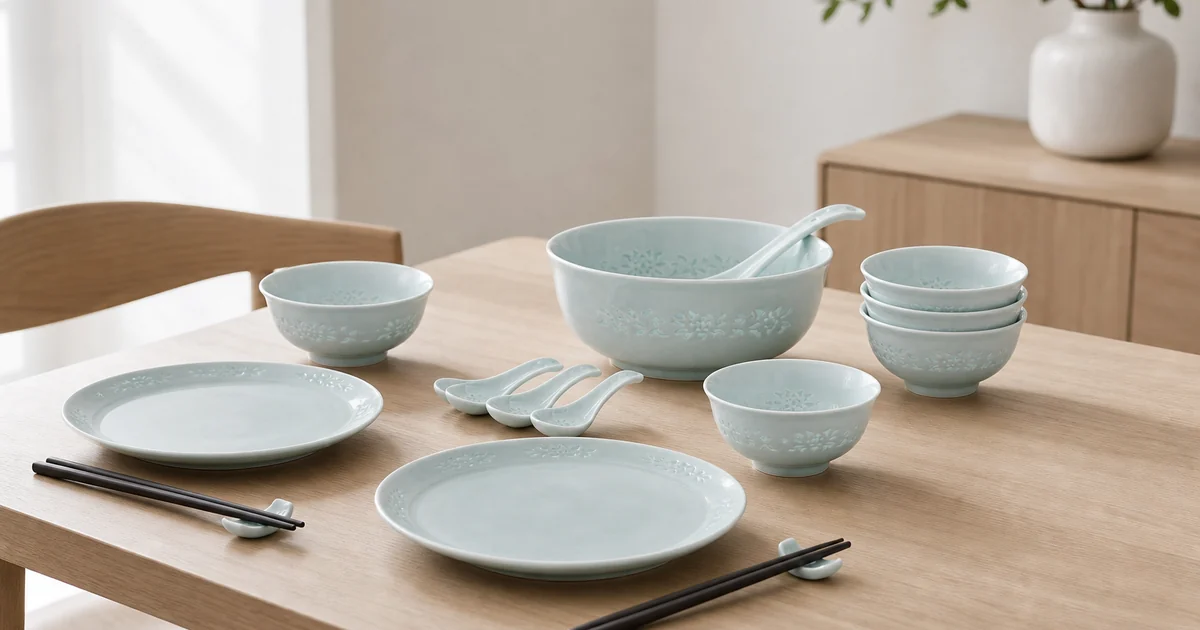
Choosing a ceramic dinnerware set starts with the contents list, not the headline piece count. The featured pale celadon floral collection comes in 22, 36, 40, 66 and 70-piece configurations, but those totals include bowls, plates, spoons, individual chopsticks and, in larger sets, serving pieces. This guide explains how to match the real contents to everyday meals, guest service and cupboard space without treating the piece count as a number of people served.
Choose the smallest configuration that includes the vessels you will use regularly and that fits your storage. The 22-piece set is a compact bowl-and-plate group for lighter needs. The 36-piece set adds more plates and side dishes. The 40-piece set introduces a lidded soup pot and oval fish platter. The 66 and 70-piece sets expand the repeated place pieces and add chopstick rests, while the 70-piece option also adds two more noodle bowls, an ashtray and a toothpick holder.
Do not convert 22, 36, 40, 66 or 70 pieces into 22, 36, 40, 66 or 70 diners. The count includes utensils and accessories, and every set lists ten individual chopsticks rather than ten pairs. Read the exact configuration row before ordering.
The useful decision is therefore three-part: confirm the pieces you need for serving, check how many repeated bowls and plates you want, and measure shelves for the larger serving shapes. Style comes after those practical checks.
A dinnerware piece count is the sum of every listed item. One plate, one bowl, one spoon and one chopstick each contribute to the total. That makes the number useful for inventory, but it is not a reliable shorthand for place settings.
Start by separating repeated eating pieces from shared serving pieces and accessories. A set with a soup pot or fish platter may have a higher total because it supports a different serving style, not because it automatically serves more people.
The 22-piece option emphasizes four rice bowls, two deep plates, one open soup bowl and spoons. The 36-piece option raises the repeated plate, side-dish and rice-bowl quantities to six. These smaller configurations make sense when you do not need the lidded serving shapes.
The 40-piece option adds a lidded soup pot, fish platter and large deep plate, while keeping six rice bowls and six main plates. The 66-piece option increases many repeated items to ten and includes ten chopstick rests. The 70-piece option keeps that larger base, increases noodle bowls from two to four and adds the ashtray and toothpick holder listed on the product page.
Think through one real meal. If you usually serve from a few shared dishes, check whether you need a fish platter, lidded soup pot or large deep plate. If most meals are simple, extra serving pieces may spend more time in storage than on the table.
Then consider the pale celadon color and raised floral band. The coordinated look is visually quiet and works best when you want bowls, plates and spoons to read as one family. Decorative props seen in styled images are not included.
Measure shelf width, depth and usable height before choosing a large set. Round plates can stack, but the lidded soup pot and oval fish platter need their own footprint. Leave enough clearance to lift pieces without knocking glazed rims together.
Handle ceramic pieces individually, wash gently and dry them before storage. The product information does not establish dishwasher, microwave or oven suitability, so those capabilities should not be assumed. Avoid sudden temperature changes unless the product instructions specifically permit them.
Choose 22 or 36 pieces when storage is limited and you do not need the lidded soup pot or fish platter. Choose 40 pieces when those serving shapes matter but ten repeated bowls and plates would be excessive. Consider 66 or 70 pieces when you regularly need larger repeated quantities and have dedicated storage.
Choose another product if you require verified porcelain, hand-painted decoration, dishwasher safety, microwave safety, oven safety or chip resistance. Those are separate product requirements, not conclusions that can be drawn from this set description.
Use the exact contents below as a decision aid. Quantities are pieces, and chopsticks are individual units.
| Option | Main listed contents | Best question to ask |
|---|---|---|
| 22 pieces | 1 soup bowl, 2 deep plates, 4 rice bowls, 1 large spoon, 4 small spoons, 10 individual chopsticks | Are compact basics enough? |
| 36 pieces | 1 soup bowl, 6 deep plates, 6 side dishes, 6 rice bowls, 1 large spoon, 6 small spoons, 10 individual chopsticks | Do you need six repeated place pieces? |
| 40 pieces | Lidded soup pot, fish platter, large deep plate, 6 rice bowls, 2 noodle bowls, 6 plates, spoons, side dishes and 10 alloy chopsticks | Do you need larger serving pieces? |
| 66 pieces | Serving pieces plus 10 rice bowls, 2 noodle bowls, 10 plates, 10 small spoons, 10 side dishes, 10 rests and 10 chopsticks | Can your table and cupboard support the larger set? |
| 70 pieces | 66-piece base with 4 noodle bowls, 1 ashtray and 1 toothpick holder | Will the added accessories be useful? |
Use these live pages to verify the product, compare the category and plan nearby kitchen tasks and storage.
No. The total counts every bowl, plate, spoon, individual chopstick and serving piece. It is not a diner or place-setting count.
The 40, 66 and 70-piece configurations list both. The 22 and 36-piece options use an open soup bowl and do not list the fish platter.
No. Each configuration lists ten individual chopsticks, not ten pairs.
The 70-piece option increases noodle bowls from two to four and adds one ashtray and one toothpick holder.
Those capabilities are not established by the product page. Follow the delivered care instructions and do not assume appliance suitability.
Oct 16, 2026 by SW SW
Oct 16, 2026 by SW SW
Cookie preferences