Oct 01, 2026 / By SW-SW / in Buying Guides Product Tips Home & Lifestyle
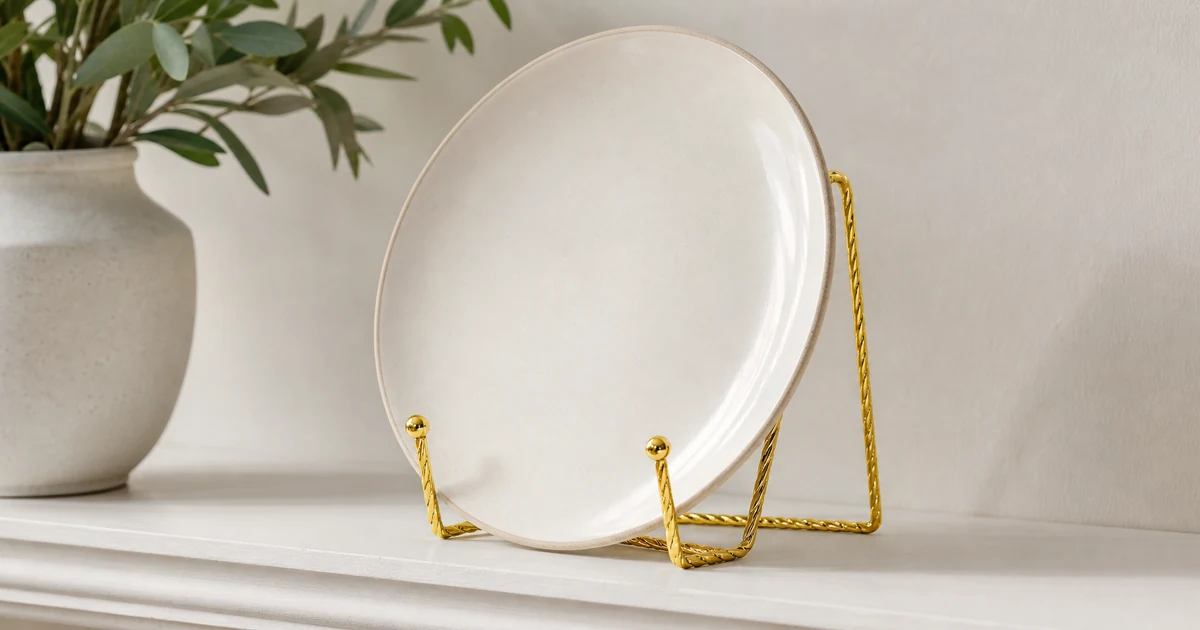
Choose a plate display stand by considering the stand's height, the plate's diameter and profile, and how the lower edge rests behind the front hooks. A stand height is not a plate-diameter limit or a load rating. A sizing illustration can help shortlist a size, but it cannot guarantee that every plate with the same diameter will sit securely.
Measure your plate across its center and examine its depth and lower rim. Then compare those measurements with the stand's documented dimensions and examples. Two plates with the same diameter can have different profiles and contact points, so diameter alone is not a complete fit check.
The iron tabletop plate display stand is offered in black or gold, with listed stand sizes of 3, 4.5 or 6 inches. Its wire frame has two rounded front hooks and a raised rear support. The selected stand is the item being purchased, rather than the plate or frame shown in a display example.
The product sizing illustration pairs the three stand sizes with example plate diameters of 7, 9 and 10 inches respectively. Use these pairings as starting points for comparing the options, not as tested minimum or maximum limits. They do not specify an allowable plate weight or cover every rim shape.
| Listed stand size | Metric equivalent | Illustrated plate diameter | Still to confirm |
|---|---|---|---|
| 3 in | 7.62 cm | 7 in / 17.78 cm | Rim contact, rear support and suitable weight |
| 4.5 in | 11.43 cm | 9 in / 22.86 cm | Rim contact, rear support and suitable weight |
| 6 in | 15.24 cm | 10 in / 25.4 cm | Rim contact, rear support and suitable weight |
The metric values are unit conversions, not additional measured specifications. Avoid calculating a universal plate size from a fixed stand-to-plate ratio: the actual wire geometry and the object being displayed both matter.
The lower plate edge needs a suitable resting position behind the two front hooks, with the back of the plate meeting the rear support. A deeper plate, an unusual rim or a raised foot ring can change those contacts. A photograph of one plate in place does not establish the fit of a different plate.
If you already have the stand, check the arrangement gently while supporting the plate by hand. Do not leave an object unattended if it rocks, slips, misses a support point or appears poorly balanced. For heavy, valuable or irreplaceable pieces, obtain a documented display solution suited to that object rather than relying on a generic sizing example.
Use a level, steady surface with enough depth for the complete stand and object. Keep the arrangement away from the edge and from places where a curtain, door or passing person could disturb it. A small stand placed in a quiet spot and the same stand placed on a busy counter are different display situations.
This is a tabletop easel, not evidence of a wall-hanging system. Do not add a suspension method or assume the front hooks can serve a different mounting purpose.
No. The product is also described for photo-frame and cookbook display, but each object needs its own check. Consider the full outer frame, including its lower edge and thickness, rather than only the print size. A cookbook's thickness and open or closed position can change its resting shape; no page-holding or book-weight rating is supplied.
Choose the finish and one listed stand size before ordering. Each retail unit contains one stand; the current minimum purchase is ten stands. Recheck the product page for the available options and ordering terms.
For other presentation formats, browse framing and display accessories.
No. The number identifies the stand size. Its sizing illustration uses a 10-inch plate as an example, but that is not a universal compatibility or weight guarantee.
No. They are illustrated diameters paired with the stand sizes. No maximum supported weight is provided.
Yes. Their depth, rim shape and rear profile can alter how they contact the hooks and rear support.
No. Compare your frame's outer size and contact surfaces separately. A display example is not a guarantee for another object.
Oct 16, 2026 by SW SW
Oct 16, 2026 by SW SW
Cookie preferences